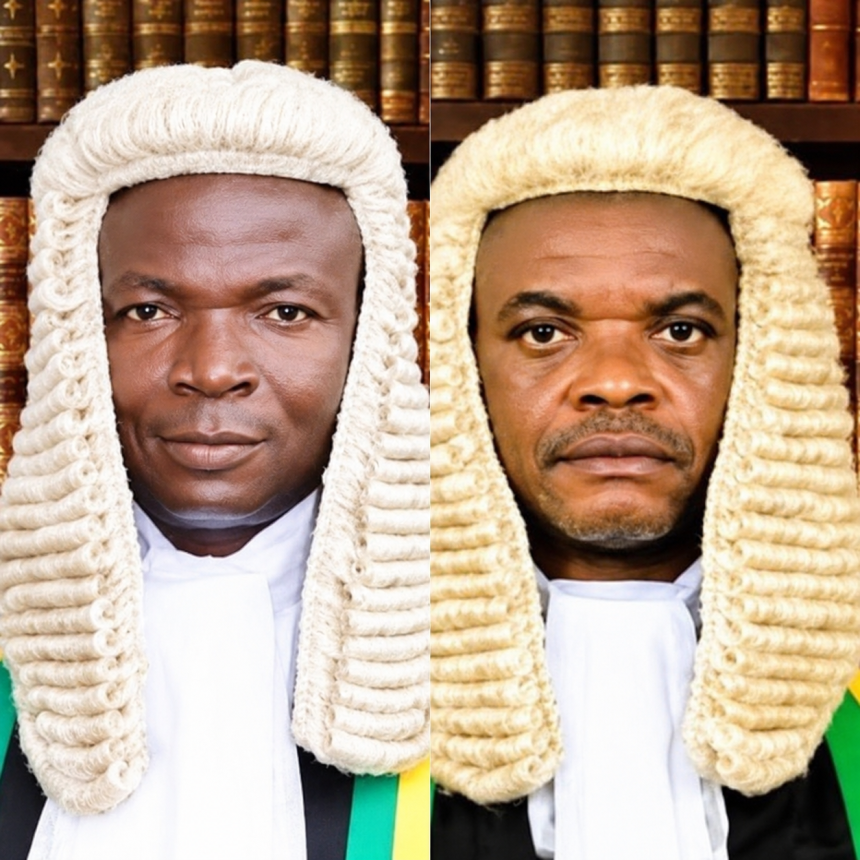
The Chief Justice of Nigeria (CJN), Justice Kudirat Kekere-Ekun, on Tuesday swore in 12 new Justices of the Court of Appeal, including Federal High Court judges James Omotosho and Emeka Nwite, whose elevation will affect several high-profile criminal cases they previously handled.
The National Judicial Council (NJC) had recommended the appointment of the 12 justices at its meeting on May 13.
Justice Omotosho had, on November 20, 2025, convicted and sentenced the detained leader of the proscribed Indigenous People of Biafra (IPOB), Nnamdi Kanu, to life imprisonment after finding him guilty on seven terrorism-related charges filed by the Federal Government.
Similarly, Justice Nwite is handling the N80.2 billion fraud case involving former Kogi State Governor, Alhaji Yahaya Bello.
The judge had also, on June 3, convicted and sentenced four members of the Al-Shabaab terrorist group to death by hanging for their roles in the June 5, 2022 attack on St. Francis Catholic Church in Owo, Ondo State.
Following their elevation, all criminal cases previously before the judges, including Bello’s fraud trial, will be reassigned to other judges of the Federal High Court and heard de novo, meaning the proceedings will begin afresh.
The other justices sworn in by the CJN are Yakubu Abdulhammeed Mohammed, Abodunde Monisola Oluwatoyin, Ajuwa Raphael, Abua Elias Ojie, Ijohor Mbalamen Jennifer, Shuaibu Sabiu Bala, Buba Dauda Njane, Kado Sanusi, Ademola Enikuomehin and Dadom Julcit Veronica.
Speaking at the ceremony, Justice Kekere-Ekun said the appointments brought together judicial experience from different parts of the country and courts with distinct jurisdictions and responsibilities.
She disclosed that some of the new justices were selected from Gombe, Bayelsa, Cross River, Benue, Kebbi, Taraba and Ondo, following their service at the High Court, National Industrial Court and Customary Courts of Appeal in Ekiti and Plateau states.
The CJN urged the newly appointed justices to embrace collective deliberations and judicial engagement, noting that their new responsibilities would require them to sit in panels rather than determine cases individually.
She said their duties extended beyond affirming or setting aside decisions of lower courts to promoting consistency in the application of the law, clarifying legal principles, correcting errors and contributing to the development of jurisprudence.
Justice Kekere-Ekun cautioned them against allowing public opinion, political interests, financial considerations or personal relationships to influence their decisions.
She stressed that judicial independence must be protected against all forms of pressure, adding that the justices must conduct themselves in a manner that leaves no reasonable doubt about their impartiality.
The CJN also urged them to pay attention to the quality and clarity of their judgments, noting that judicial decisions increasingly attract immediate public scrutiny.
She reminded the new justices that the law must be applied consistently, fairly and without prejudice.